
VIP transport for events: how to organise flawless transport management
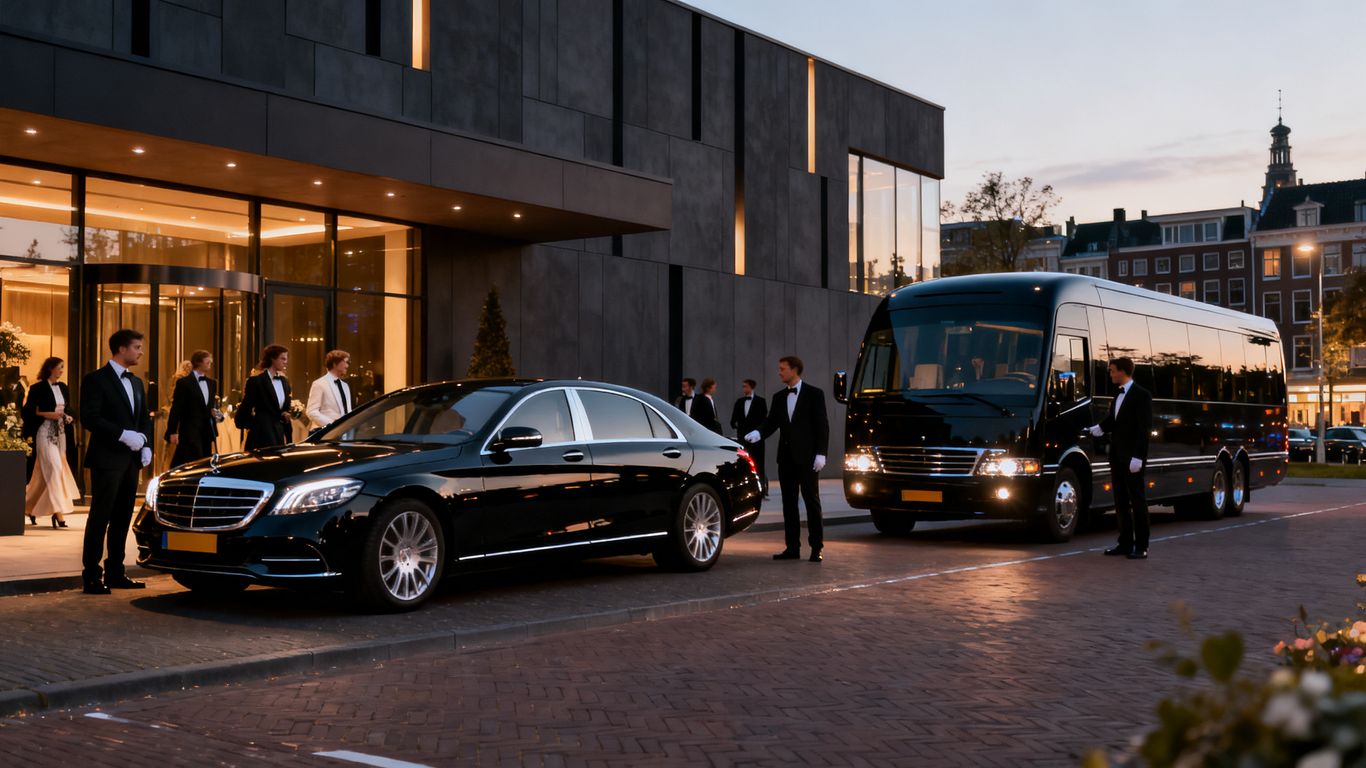
Key Points to Consider
Flawless transport management begins well before the first guest steps into the vehicle. Identifying transport flows, responsibilities, and potential disruptions beforehand creates peace of mind for both guests and the organisation.
Map out numbers, profiles, locations, and arrival times early on.
Match the vehicle type and chauffeur to the guest and the itinerary.
Work with a single, central point of contact for all transport flows.
Plan buffers, back-up options, and clear communication for peak times.
Evaluate the execution to ensure the next event runs even smoother.
What Sets VIP Event Transport Apart
VIP transport for events is about more than just having a comfortable car waiting at the door. It is an integral part of hospitality, security, and the overall image of the event. The guest should feel that everything happens effortlessly: the right car is ready, the chauffeur knows the schedule, and adjustments are handled calmly. Behind this seamless experience lies a meticulously planned operation.
More Than Just Luxury and Comfort
Luxury is visible, but it is not the most important factor. A prestigious vehicle, plenty of legroom, and a smooth ride help the guest arrive relaxed. Quality also lies in the preparation: a route that aligns with the schedule, an appropriate pick-up location, and sufficient time between arrival and the next agenda item.
For exclusive gatherings, transport can also serve as a transition point. An international guest gets the opportunity to recover from their journey, an executive can work on the go, and a speaker arrives without additional logistical stress. In this way, transport supports the entire visitor experience rather than just moving people.
Discretion, Punctuality, and Personal Service
VIP guests do not necessarily expect constant attention; in fact, often quite the opposite. A professional chauffeur knows when interaction is appreciated and when peace and quiet are preferred. Professional communication, a neat appearance, and careful handling of information are therefore key parts of the service.
Punctuality also means more than just departing on time. The chauffeur must know where the guest is being picked up, which access point is available, and how much margin the schedule allows. An up-to-date briefing prevents a guest from having to explain their schedule again upon arrival.
A Single Point of Contact for All Transport Flows
As soon as an event involves multiple hotels, vehicles, and arrival windows, the risk of misunderstandings increases rapidly. A central dispatch hub coordinates communication with the event team, chauffeurs, venues, and any security teams. This speeds up decision-making when a flight is delayed or an agenda item runs over.
Anyone who looks into central event transport understands why a single point of contact is more than an administrative choice. It gives the organisation a clear overview and makes it easier to coordinate VIP transport, group transport, and shuttle services. As a result, the guest receives one consistent service, even when multiple teams are working behind the scenes.
The Impact on the Total Visitor Experience
For many guests, the journey begins at the airport, train station, or hotel. A confusing pick-up spot or a long wait can influence the first impression of an event before the program has even started. Conversely, a smooth reception contributes to the feeling that the organisation takes care of its guests.
This effect also carries through after the event. A well-organised return journey avoids crowding at the exit and helps guests catch their connecting train, flight, or dinner. Transport is therefore not an isolated part of the event, but a visible link in the guest journey.
Mapping Your Event's Transport Needs
Good planning starts with questions that may seem simple but make a major difference in practice. How many people are coming, when do they arrive, and which groups have a different schedule? Locations, access points, and parking restrictions also determine which solution is feasible. By gathering this information before the quote and execution phase, assumptions are replaced with a workable transport plan.
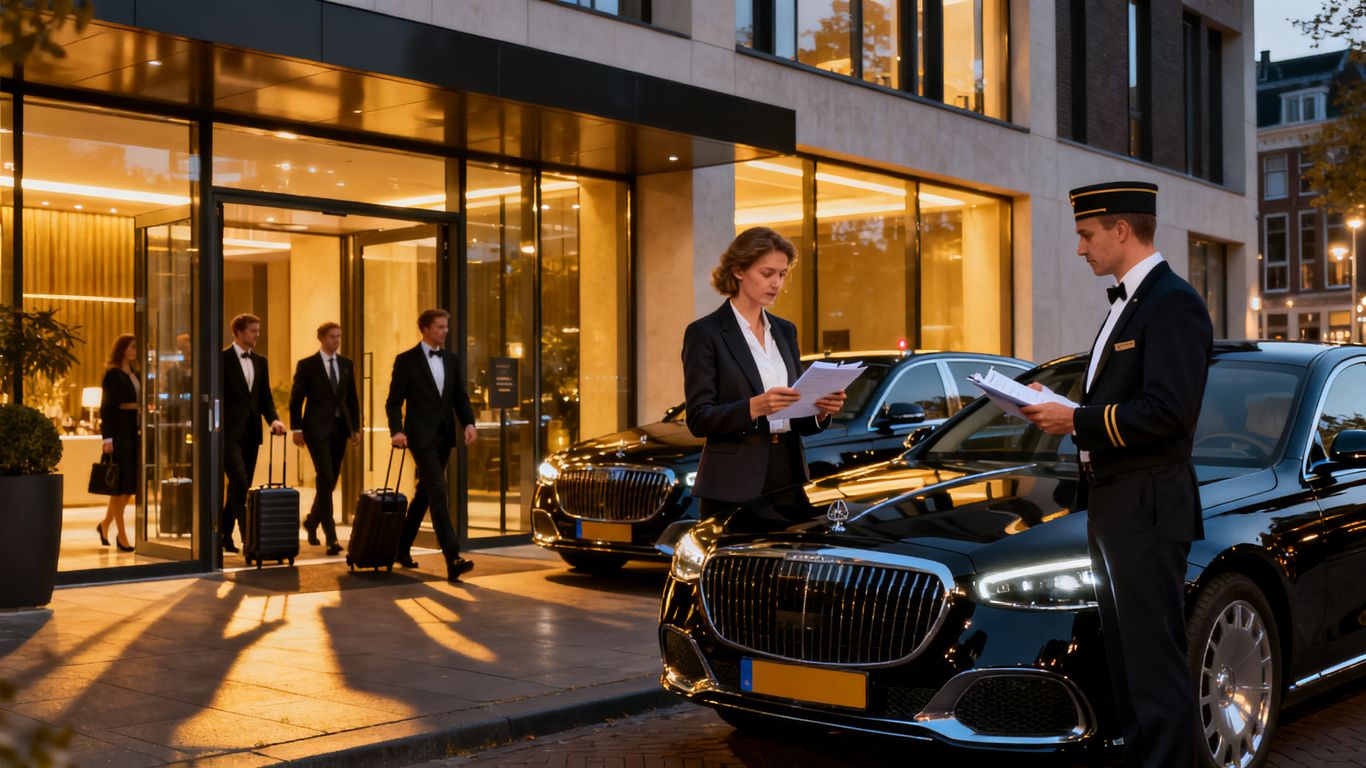
Taking Inventory of Guest Numbers and Arrival Times
First, create a timeline of all relevant arrivals and departures. Include not only the official start time but also flight details, hotel check-outs, sound checks, rehearsals, and any networking programmes. After all, a speaker arriving twenty minutes late can affect an entire transport chain.
Work with time windows rather than just a single scheduled time. This allows room for luggage, meet-and-greets, and walking to the vehicle. For large numbers of guests, it is wise to review the schedule per location and arrival wave to see where capacity will temporarily peak.
Distinguishing VIP Guests, Staff, and Crew
Not every passenger has the same needs. VIP guests may travel individually or in small parties, whereas staff and crew often move at fixed times and in larger groups. A production crew may also require vehicles that support equipment transport, planning teams, or backstage personnel.
Define what information the chauffeur needs for each group and who is authorised to request changes. Consider contact persons, access rights, luggage, privacy requirements, and the time the group needs to be on-site. This segmentation increases efficiency without losing the personal touch for VIP guests.
Analysing Locations, Routes, and Parking Options
A route on a map is not automatically a viable event route. Check loading and unloading zones, temporary traffic measures, height restrictions, entrance numbers, and the distance between the parking area and the reception. At a conference venue, the main entrance might not be the best spot for a discrete VIP arrival.
The surroundings also deserve attention. In busy areas or near airports, congestion and limited space can affect execution. Therefore, make arrangements beforehand regarding alternative routes and secure waiting areas. This ensures the chauffeur does not have to search for a solution during a peak moment.
Accounting for Changes and Peak Moments
A plan is stronger when it does not just describe the ideal scenario. Note which elements are sensitive to delays and decide in advance who makes the decisions. Where necessary, reserve vehicles or chauffeurs for shifting arrival times, without making the entire operation unnecessarily heavy.
A practical inventory should include at least the following details:
an up-to-date guest list with categories and contact persons;
arrival and departure times with realistic buffers;
addresses, access points, parking, and waiting locations;
agreements on changes, escalations, and replacement transport.
Following this inventory, a shared vision of the operation is formed. This vision serves as the foundation for vehicle selection, chauffeur briefings, and communication with the event team.
Selecting the Right Vehicles and Chauffeurs
The vehicle must suit the purpose of the journey, not just the desired aesthetic. An executive with multiple meetings has different space and privacy requirements than a group of staff members travelling to a conference venue at the same time. The organisation's image and the venue's accessibility also play a role.
A Fleet That Fits Your Guests and Image
A prestigious sedan may be suitable for individual executive travel, while a spacious minibus makes more sense for a small VIP party with luggage. For larger groups, coaches or shuttle vehicles are often more efficient. Also consider boarding convenience, luggage capacity, and the feasibility of bringing vehicles close to the entrance.
The choice must be checked against the route beforehand. A vehicle that performs excellently on the motorway is not always practical near a narrow backstage entrance. A brief vehicle assessment prevents image and feasibility from being evaluated separately.
When to Choose Executive Transport vs. Coaches?
Executive transport is ideal for individual guests, small delegations, and itineraries with multiple meetings. The chauffeur can then adapt to a changing schedule and the guest's need for rest or business preparation. Coaches are best suited when many guests follow the same route and roughly the same timetable.
For mixed groups, a combination often works better than a single uniform solution. VIP guests can be transported individually, while staff travel to the venue via shuttle services. Group transport for events helps in assessing vehicle capacity, scheduling, and hospitality for different group sizes.
Dedicated Chauffeurs and Consistent Service Quality
A dedicated chauffeur brings continuity to an itinerary with multiple transfers. The chauffeur knows the route, the contact persons, and the agreed way of working. For the guest, this feels more reassuring than meeting a new driver each time, especially during a multi-day event.
A chauffeur is also part of the welcome. He or she must communicate professionally, remain discreet regarding conversations, and stay alert to any changes. This quality is not achieved merely by booking a vehicle, but by organizing briefing, selection, and follow-up as a cohesive whole.
Combining Safety, Comfort, and Professionalism
Safety begins with a suitable route, a well-rested chauffeur, and sufficient buffers in the schedule. Comfort requires a clean vehicle, a smooth pick-up, and room for luggage. Professionalism is then found in the entire experience: from the first communication to the moment the guest steps out at the entrance.
Stuur Chauffeurs describes executive transport as transport with dedicated chauffeurs for executives, with discretion, flexibility, and punctuality as guiding principles. These principles are equally relevant for events, as long as execution is tailored to the specific programme and the various transport flows.
Organising Logistical Coordination on the Day
When guests arrive at multiple locations, the focus shifts from individual journeys to overall chain management. The dispatcher must know where vehicles are positioned, which chauffeur is receiving which guest, and how the operation responds to delays. This requires a run sheet that is practical enough for execution and clear enough for the organisation.
Planning Transfers from Airports, Hotels, and Stations
Link every transfer to a specific arrival location, contact person, and destination. For airport transport, flight details and luggage are crucial parts of the plan; at train stations, the platform, exit, and walking distance often play a larger role. Hotel transfers, in turn, require clear communication with reception and the concierge.
Do not just plan the outbound journey. The return trip, potential stopovers, and connections to a dinner or flight belong in the same chain. This keeps it clear where a small delay could have knock-on effects later in the programme.
Utilising Pre-positioning and Shuttle Services
Pre-positioning means placing vehicles at the correct location ahead of an expected peak. This could be at a hotel, an entrance, or a backstage zone. This measure minimises wait times but only works when parking rights, chauffeur briefings, and departure times are coordinated in advance.
Shuttle services are useful when many guests move between a parking area, hotel, and the event grounds. The stop, frequency, and capacity must align with the actual flow of visitors. A professional shuttle approach therefore starts with demand forecasting and ends with active monitoring during execution.
Coordinating On-Site Transport and Backstage Logistics
On-site, short trips can require just as much attention as long transfers. Think of transport between the car park and the entrance, between the hotel and the production location, or between backstage and a secure exit. Define which vehicles have access and which staff member manages the journeys on-site.
For crew and production, it is important that passenger transport does not conflict with equipment flows. Separate loading and unloading agreements, a recognisable check-in point, and an up-to-date contact list prevent chauffeurs from waiting on each other. This keeps logistics functional yet discreet.
Adjusting for Delays, Changes, and Unexpected Situations
A delay requires a decision, not multiple disconnected phone calls. Agree in advance who decides on priorities, which guests are informed directly, and when a vehicle is rescheduled. Also account for a changed entrance, a closed road, or an overrunning agenda item.
A clear escalation model can have three levels: local resolution, central rescheduling, and informing event management. This keeps communication proportionate. The organisation retains control, while chauffeurs can focus on safe and hospitable execution.
Technology and Communication During Execution
Technology supports coordination, but it does not replace personal contact. Its value lies mainly in real-time information: who is driving, which vehicle is assigned, and when is the guest expected? With this data, dispatchers can act faster and organisers can answer queries without calling multiple chauffeurs individually.
Real-Time Insights into Journeys, Chauffeurs, and Vehicles
A central overview makes the schedule manageable during the event. The coordinator can see which journeys are underway, where attention is needed, and what capacity is available. This is particularly useful when arrival times change or a chauffeur is needed at another location.
Stuur Chauffeurs mentions that it develops its own proprietary planning tool. According to the source, this scheduling tool can be linked to client systems and custom reports can be configured; it also shows in real-time who the chauffeur is, which vehicle the guest is travelling in, and when the chauffeur is expected. The application must always align with the agreed workflow and data rights.
Informing Guests and Organisers in a Timely Manner
Communication works best when it is brief, concrete, and timely. A guest wants to know where they are being picked up and who is receiving them; an organiser wants to know if the schedule is on track. Therefore, use standardised messages for confirmation, arrival, delay, and changes.
Too many messages, however, can cause confusion. Determine in advance which information goes to the guest and which is strictly for event management. For international guests, multilingual instructions or a clear location description can make all the difference.
Linking Central Scheduling to Your Own Systems
An integration can reduce double data entry, for example, when guest registration, calendars, or flight details are already in another system. Define beforehand which data is exchanged, how often the information is refreshed, and who is responsible for corrections.
Transparency also helps when choosing a domain or digital platform: Cobytes, for instance, describes domain registration, DNS management, and DNSSEC security. While separate from event transport, it illustrates why technical agreements must be clear before a digital workflow becomes part of the operation.
Ensuring the Privacy and Confidentiality of VIP Guests
A guest list can contain sensitive information. Therefore, restrict access to only what is necessary for a role, and do not share complete programmes with individuals who are only performing a single transfer. Also agree on how data is stored or deleted after the event.
The privacy statement of TrimsalonCharmee relates to a different service, but serves as a general example of the topics included in a privacy framework: personal data processing, sharing with third parties, cookies, and data subject rights. For an event team, this translates to clear retention periods, restricted access, and a point of contact for privacy questions.
Choosing a Reliable Transport Partner
Choosing a transport partner is not just about available vehicles. Assess also how the partner plans, communicates, and takes responsibility when the programme changes. A thorough intake process reveals whether the organisation is truly thinking ahead or simply offering capacity.
Assessing Experience with Large-Scale and Exclusive Events
Ask about comparable projects: multiple locations, international guests, VIP transfers, shuttle services, and on-site coordination. A partner should be able to explain how the schedule is structured and what information is required at what stage. Broad promises mean less than a concrete run sheet and a clear division of roles.
Furthermore, experience can take different forms. An event with thousands of staff requires different processes than a private gathering with a few board members. Look at the complexity of past assignments, not just the vehicle count.
Checking How the Partner Handles Contingencies
Ask what happens in the event of a sick chauffeur, a vehicle breakdown, extreme traffic, or a closed route. Have the partner explain not just the ideal plan, but the alternative. Who decides, who informs the guest, and how quickly can capacity be shifted?
A contingency plan does not have to be complicated. Above all, it must remain up-to-date, accessible, and understandable for everyone involved. Test the most important scenarios in advance so that an emergency solution does not become improvised at the busiest moment.
Making Agreements on Availability and Responsibilities
Define who serves as the central point of contact during preparation and execution. Additionally, describe the boundaries of responsibility: who manages the guest list, who passes on access instructions, and who decides on route changes? Clear agreements prevent a chauffeur, hotel employee, and event manager from answering the same question differently.
Also make communication availability concrete. An agreement to be available during office hours is not enough if an event starts early or ends late. The correct approach is described in outsourcing VIP transport: maintaining control requires a clear coordination point, professional preparation, and agreements on responsibilities.
Using Reports and Evaluation for Future Events
Afterwards, do not just evaluate whether all journeys were completed. Discuss wait times, changes, vehicle occupancy, quality of information, and cooperation with the venue and event team. Also ask chauffeurs and coordinators to indicate where real-life execution differed from the plan.
For specific vehicle components, technical reliability may require its own inspection process; Kia parts in Perth is an automotive example outside of event transport. The broader lesson is simple: work with verifiable maintenance and quality agreements, and record areas for improvement before the next event is planned.
A brief evaluation is often more valuable when translated directly into action. For example, adjust buffers, change a pick-up location, or make a briefing more compact. This makes each event a better starting point for the next.
Final Thought
Those who organise VIP transport as a key component of the overall guest experience look beyond vehicles and departure times. With a thorough inventory, suitable chauffeurs, central coordination, and real-time communication, seamless mobility is achieved. Therefore, start early, define responsibilities, and build in room for what might not go to plan.
Frequently Asked Questions
What is included in VIP transport for events?
VIP transport for events typically includes personal transfers for guests, executives, speakers, or international relations. Depending on the programme, airport transfers, hotel transfers, shuttle services, and transport within the event grounds can also be included.
How early should I plan event transport?
Ideally, begin as soon as the venues, guest profiles, and global schedule are known. For larger or multi-day events, extra preparation is needed for permits, parking arrangements, vehicle capacity, chauffeur briefings, and scenarios for changes.
Which vehicle is suitable for a VIP guest?
This depends on the number of passengers, luggage, route, privacy requirements, and the image of the event. Individual guests often travel more comfortably in a prestigious sedan, whereas small delegations may benefit from a spacious minibus.
When are shuttle services useful?
Shuttle services work well when many guests travel along the same route, for example between a car park, hotel, and event venue. Appropriate stop planning, sufficient capacity, and clear departure times are needed to prevent queues and confusion.
How do you handle delays?
Define in advance who assesses changes and how information is distributed. With buffers, up-to-date contact details, and alternative routes, transport management can make adjustments without each guest or chauffeur having to improvise individually.
What information does a chauffeur need?
A chauffeur needs at least the pick-up and drop-off locations, time windows, contact details, access agreements, and relevant specifics. Only share information necessary for the execution, especially when it concerns VIP guests.
How do I measure if the transport was successful?
Review punctuality, wait times, changes, communication, and how well it integrated with the schedule. Combine operational data with feedback from guests, chauffeurs, and organisers, and translate the results into concrete improvements.


Let us help you think about your mobility.
An informal consultation. We listen, analyse, and present a proposal that suits your situation.