
Discreet transport for international guests and speakers
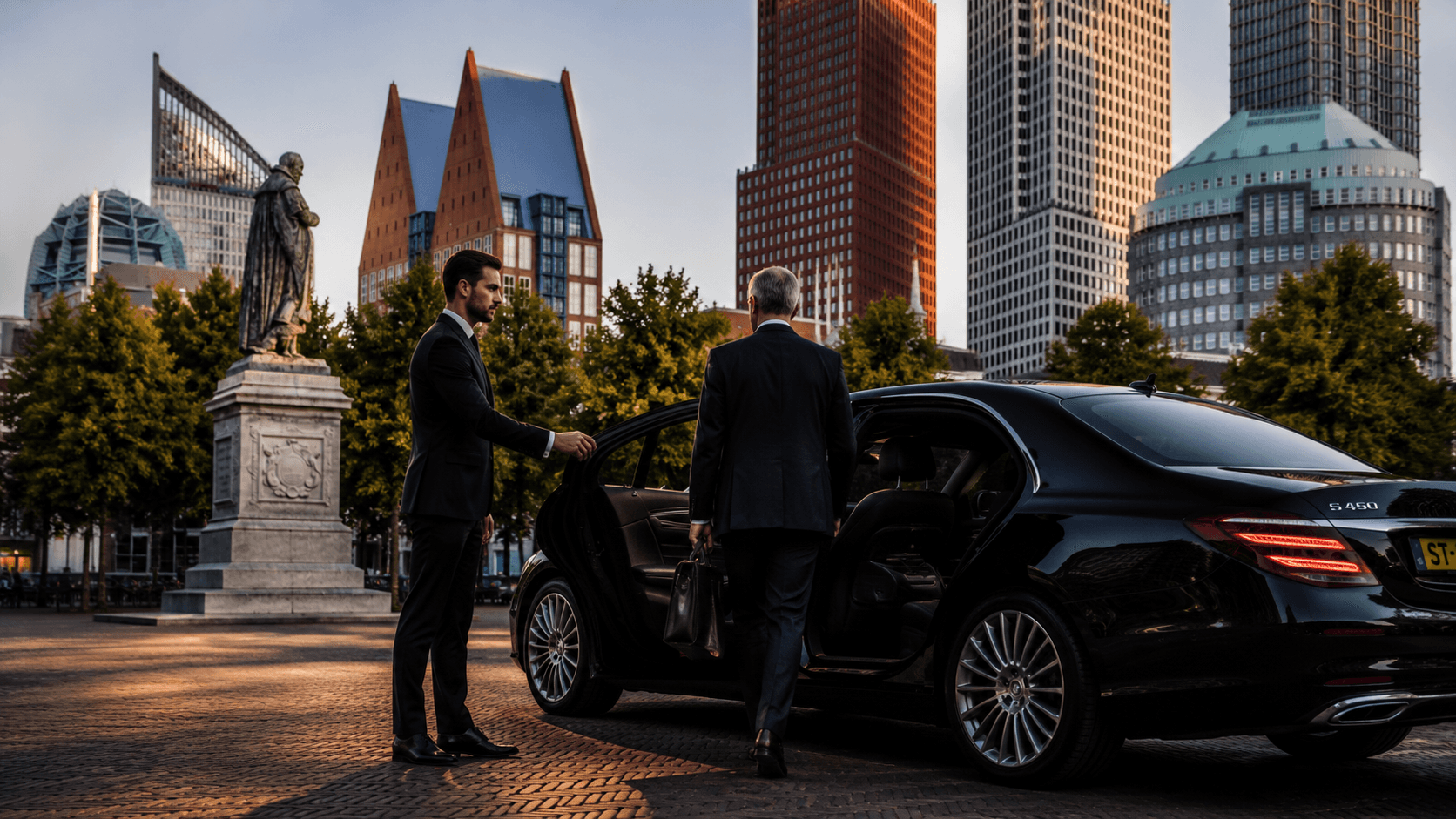
International guests, keynote speakers, investors and VIPs do not judge an organisation only when they arrive on site. The experience begins at the landing, the hotel, the first greeting and the journey to the appointment. It is precisely in those moments that discreet transport makes the difference: not visibly intrusive, but arranged exactly as it should be.
For high-end business programmes, a chauffeur is therefore not a practical afterthought. It is part of hospitality, reputation management and operational assurance. An international speaker who arrives relaxed, on time and without unnecessary distractions stands on stage differently. A foreign executive who can make calls or review documents in peace experiences professionalism even before the meeting begins.
In this article you will read what to look out for when arranging discreet transport for international guests and speakers, which choices need to be made in advance and how to prevent transport from becoming a risk rather than a calling card.
Why discreet transport requires more than a luxury car
A representative car helps, but discreet transport is mainly about behaviour, preparation and control. For international guests, the journey is often a transition moment between flight, hotel, meeting, interview, rehearsal or dinner. That moment must be calm, predictable and private.
Discretion means that the chauffeur knows when to speak and when not to. That they know routes, alternatives and arrival procedures in advance. That they understand that names, diaries and topics of conversation are confidential. And that they adapt to the level of service that suits the guest, without being prominently visible.
For organisers, executive offices and event managers, the value lies mainly in control. You want to know that the guest has been collected, that delays are dealt with in time and that changes do not have to pass through five links. Professional VIP transport therefore combines comfort with structure: one point of contact, clear agreements and chauffeurs who are used to sensitive contexts.
When is discreet transport essential?
Not every journey requires the same level of preparation. But with international guests and speakers, there are situations in which standard transport is simply too fragile. Think of a speaker with a tight stage schedule, a supervisory board member going directly from Schiphol to a board meeting or a delegation visiting several locations in one day.
Professional transport is often also decisive for the tone of the day at private dinners, press moments, investor days, award shows and closed events. Guests should not have to look for a taxi, arrive at the wrong entrance or wait among the public and the press. The journey must fit the protocol, security and hospitality of the programme.
Type of guest or speaker | Main transport objective | Discretion point to note |
|---|---|---|
Keynote speaker | Arrive on time and relaxed for stage, briefing or rehearsal | Calm arrival, short walking route and coordination with the event team |
International executive | Use travel time for calls, reading or consultation | Confidentiality, stable planning and minimal communication |
VIP guest or private guest | Comfortable reception without visible friction | Unobtrusive pick-up, representative vehicle and appropriate approach |
Delegation | Move multiple people in a coordinated way | Central control, clear order and back-up in case of delay |
Guest with connecting flight | No loss of time between airport, hotel and venue | Flight monitoring, buffer planning and flexible route choice |
The airport as the first quality moment
For international guests, the experience often begins at Schiphol, Rotterdam The Hague Airport, Eindhoven Airport or a foreign airport with arrival in the Netherlands. It is precisely there that most variables arise: delayed flights, changed gates, baggage problems, customs, crowds at kiss & ride zones and unfamiliarity with the area.
Professional airport transport prevents a guest from having to navigate on their own after a long journey. The chauffeur and coordination are prepared for flight times, luggage, arrival location and follow-up planning. The guest does not have to search or call, but is guided to the car in a calm and appropriate manner.
For speakers, that difference is tangible. A delayed landing does not have to lead directly to stress for the event team, provided scenarios have been agreed in advance. Can the guest go to the hotel first or straight to the venue? Where can the car wait? Who decides in the event of a delay? Which contact person takes the lead? These kinds of agreements make transport robust.
From guest profile to transport plan
Discreet transport begins with a short but targeted intake. Not with the question “what time should the car be there?”, but with the question of what the journey needs to protect: time, peace, privacy, image or continuity.
For an international speaker, the priority is often punctuality and calm. For an executive, it is more about confidentiality and predictability. For a VIP guest, it is a combination of comfort, representation and unobtrusiveness. The transport plan should be designed accordingly.
A good preparation includes at least the following elements:
Arrival and departure times, including flight or train references.
Hotel, venue, backstage entrance, meeting location and any stopovers.
Name and phone number of the operational contact person.
Desired level of service, vehicle type and any language preference.
Instructions on privacy, communication and visibility upon arrival.
Buffer arrangements in the event of delays, overruns or programme changes.
This information does not need to be extensive. In fact, with discreet transport, the rule is often: share what is necessary, not more than necessary. A professional mobility partner can arrange a great deal with compact information, provided responsibilities are clear.
The chauffeur as an extension of your organisation
An international guest often sees the chauffeur as the first representative of your organisation. The chauffeur’s attitude must therefore suit the context: presentable, calm, helpful and correct. Not overly familiar, not pushy and never unprepared.
With executive transport, that role is even more important. Executives and board members often use travel time as a workspace. They make calls, read documents or prepare for a meeting. The chauffeur ensures that environment remains stable: smooth driving style, minimal interruptions and clear communication when needed.
For speakers, the emphasis is often on timing and mental calm. A good chauffeur understands that the journey to a stage or boardroom is not an ordinary transfer. The guest should not have to think about parking, routes, queues or unclear instructions. That is exactly where professional chauffeur work distinguishes itself from standard passenger transport.
Communication without noise
With international transport, several parties are often involved: the secretariat, the event manager, the hotel, the venue, security, the guest’s personal assistant and sometimes an agency or management team. Without a clear line of communication, confusion arises. Who calls the chauffeur? Who changes the journey? Who informs the guest? Who has the final say in the event of delay?
The best solution is one operational point of contact. That can be internal or with the mobility partner. What matters is that everyone knows where changes come in and who confirms them. This prevents the chauffeur, guest and event team from working with different information.
The tone of communication also matters. International guests appreciate short, clear and correct instructions. Think: “Your chauffeur will meet you at the hotel lobby at 18:20” or “The vehicle is positioned at the backstage entrance after your keynote.” No long messages, no unnecessary details and no uncertainty.
For organisations that want to prepare their hospitality, sales or service teams for sensitive guest scenarios, AI-driven scenario training can help to practise communication, role discipline and responses to unexpected situations. Especially in high-end reception, it is often the small moments in which calm and consistency make the difference.
Event transport for international speakers
At congresses, summits, private leadership events and international corporate events, transport is part of the total guest journey. A speaker cannot arrive “roughly on time”. The schedule often includes rehearsal, technical checks, reception by the host, the stage programme, interviews, networking dinner and departure.
That is why event transport for speakers calls for a schedule per guest category. A keynote speaker may get a different route, entrance and waiting area from regular VIP guests. A delegation may need vehicles that can arrive one after another. A moderator may need to get quickly to a next location afterwards, while other guests leave in stages.
Important questions for the planning are:
Which guests are time-critical for the programme?
Which guests must stay outside the regular guest flow?
Where can vehicles wait safely and discreetly?
Which routes are vulnerable due to traffic, road closures or congestion?
Who coordinates departures afterwards, especially if things overrun?
The answer to these questions determines the vehicle mix, chauffeur briefing, waiting times and back-up. The earlier this is fixed, the fewer ad hoc decisions are needed on the event day.
Discretion and privacy in practice
Discretion is not an abstract concept. It lies in concrete choices. A chauffeur who does not say a guest’s name aloud in a busy lobby. A vehicle that does not wait unnecessarily long in front of the entrance. A route that allows the guest to make calls in peace. A plan in which no more people than necessary have access to passenger details.
For international guests, it is also important that cultural and personal preferences are respected. Some guests want minimal interaction. Others expect guidance on arrival or help with luggage. The skill is to make that clear in advance and then execute it consistently.
For confidential journeys, it is sensible to limit information to what is operationally necessary. The chauffeur does not need to know what is being discussed, only where and when the guest must arrive. The event team does not need to share all private details, only the correct contact moments. This pragmatic approach suits professional discreet transport.
Vehicle choice: representative, suitable and functional
The right car depends on the guest, the programme and the context. For one executive or speaker, a representative saloon is often suitable. For a small delegation, a more spacious car or luxury van may be more logical. At events, a combination of vehicles may be needed, with different levels of service per guest group.
It is important that the car not only looks luxurious, but is also functional. Can the guest work comfortably? Is there enough luggage space? Does the vehicle suit the entrance and route? Is the arrival stylish without attracting too much attention?
For highly personal or private journeys, a private chauffeur may be suitable. In other cases, a service with vehicle and chauffeur is better, for example when international guests do not have their own car available or when uniformity of appearance is important. For executives travelling in their own trusted vehicle, a chauffeur in their own car can be efficient and discreet.
Common mistakes in transport for international guests
Most problems do not arise from the journey itself, but from insufficient preparation. A chauffeur can drive excellently, but without clear instructions the operation remains vulnerable. Especially with international guests, small ambiguities quickly become visible.
A common mistake is booking too late. That leaves less room for a suitable chauffeur, the right vehicle and route checking. A second mistake is the absence of a central contact person. Then changes start to run through assistants, hotel staff and event teams all mixed together.
Arrival at the location is also regularly underestimated. A venue may have several entrances, use security procedures or offer limited stopping space. If the chauffeur only hears on the day itself which entrance is needed, unnecessary delays arise.
Finally, discretion is sometimes confused with aloofness. A discreet chauffeur is not cold or absent. On the contrary, they are alert, correct and service-minded, but without drawing attention to themselves.
What should a quote for discreet transport be based on?
A sharp quote requires more than date, time and address. The more specific the operational context, the better the mobility partner can advise. That does not mean everything has to be fixed to the minute, but it does mean that the main conditions are known.
For a realistic quote, the following details are usually relevant:
Number of guests, speakers or delegation members.
Arrival and departure locations, including airport, hotel and event venue.
Desired availability per chauffeur or vehicle.
Expected waiting times and likelihood of overruns.
Vehicle preference, luggage needs and comfort level.
Degree of coordination, for example individual journeys or complete transport management.
Privacy and communication arrangements.
For programmes with multiple guests, it is sensible to think not only per journey, but in blocks or guest flows. That makes planning more efficient and prevents vehicles from standing idle unnecessarily or, conversely, not being available at peak times.
How Stuur Chauffeurs supports this
Stuur Chauffeurs works for organisations where mobility must be reliable, representative and flexible. For international guests and speakers, that means experienced chauffeurs, clear preparation, one point of contact and tailored solutions for each programme.
Depending on the situation, this may involve one discreetly planned transfer, a full-day schedule for a speaker, several vehicles for an executive programme or complete transport management around an event. The approach is aligned with the guest, the level of service and the degree of complexity.
For clients, the peace of mind is what matters most. You do not have to supervise every journey yourself, but you still retain control over agreements, changes and quality. In this way, transport becomes not a separate facilities task, but a professional part of your reception.
Frequently asked questions
What is discreet transport for international guests? Discreet transport is professional transport in which privacy, calm, punctuality and representation are central. The chauffeur is prepared, communicates carefully and ensures the guest arrives at the right location without unnecessary visibility or noise.
Is discreet transport only intended for VIPs? No. It is also valuable for keynote speakers, executives, investors, delegations and guests with a tight schedule. Discretion is especially important when time, image or confidentiality play a role.
How early should transport for international speakers be arranged? Preferably as soon as the flight details, hotel information and programme timings are known. For complex events, earlier coordination is advisable so that routes, buffers, vehicles and contact lines can be properly arranged.
Can a schedule still be adjusted on the day itself? Yes, but the degree of flexibility depends on availability, distance, vehicles and chauffeur planning. With a central point of contact and scenarios discussed in advance, changes can usually be handled much more calmly.
What information is needed for a quote? Think of date, times, locations, number of guests, flight details, desired vehicles, waiting times, luggage, level of service and any privacy or protocol agreements. For multiple guests, a provisional programme or running order helps.
Organise discreet transport professionally?
Are you soon expecting international guests, keynote speakers or VIPs and do you want to organise transport without noise? Stuur Chauffeurs will think along with you about the right deployment of chauffeurs, vehicles and management, suited to your programme and the desired level of service.
Discuss your planning in good time and receive a tailored proposal for representative and discreet transport. Call 010 307 4525 or contact Stuur Chauffeurs for a free, no-obligation quote.


Let us help you think about your mobility.
An informal consultation. We listen, analyse, and present a proposal that suits your situation.